


Ross Lovegrove – Organic Design Between Nature and Technology
British designer Ross Lovegrove is one of the best-known representatives of organically inspired, technologically advanced industrial design. Born in Cardiff, Wales, in 1958, he designs lights, furniture, vehicles and technical products whose flowing forms often appear to have grown naturally. His approach combines three areas that he himself summarises with the term “DNA—Design, Nature, Art”: design, nature and art. For the Italian lighting manufacturer Artemide, Lovegrove created some of the brand’s most sculptural lights with series such as Mercury, Cosmic Leaf, Droplet, Skydro and New Nature.


From Industrial Design to an International Career
Ross Lovegrove studied Industrial Design at Manchester Polytechnic, graduating in 1980 with a first-class bachelor’s degree. In 1983, he completed a Master of Design at the Royal College of Art in London. At the beginning of his career, he worked for Frog Design in West Germany on technology projects for companies such as Sony and Apple. He later moved to Paris, where he advised Knoll International and developed the successful Alessandri Office System.
In 1984, Lovegrove was invited to join Atelier de Nîmes. There, he worked in an environment shaped by designers and architects such as Jean Nouvel and Philippe Starck and contributed to consultancy projects for international brands. After returning to London in 1986, his work increasingly expanded beyond the boundaries of conventional product design. Since then, he has worked on projects for companies in fields as diverse as furniture, lighting, mobility, aviation, consumer electronics and fashion.
This broad spectrum is characteristic of Lovegrove’s work. Whether designing a chair, loudspeaker, water bottle, aircraft seat or light, his creations have a recognisable signature without being tied to any one product category. What matters less is the category itself than the question of how an object can be reimagined using the creative and technical possibilities of its time. His works are held in collections including those of the Museum of Modern Art in New York, the Design Museum in London, the Vitra Design Museum and the Centre Pompidou in Paris.
What Defines Ross Lovegrove’s Design?
For Ross Lovegrove, nature is not merely an archive of fascinating forms. He is more interested in the principles by which structures grow, adapt and emerge through the most efficient possible use of material. He combines these observations with digital design methods, contemporary materials and modern manufacturing processes.
Lovegrove describes his own approach as „organic essentialism“. This refers to a consistent form of reduction: material, volume and structure should be limited to what is genuinely required for function, effect and form. The sometimes complex, flowing shapes of his objects are therefore not intended as mere decoration. Instead, they aim to unite material, structure and function into as coherent a whole as possible.
Modern technologies play a central role in this process. Lovegrove was one of the early designers to use digital design tools and new production methods in industrial design. As a result, his forms can sometimes appear futuristic, yet they remain closely connected to nature. For him, technology is not the opposite of the natural world. Rather, it opens up new possibilities for understanding its principles and translating them into contemporary objects.
His own concise formula, “DNA—Design, Nature, Art”, captures this attitude particularly well. Design provides function and industrial feasibility, nature contributes logic and evolutionary intelligence, and art gives the object emotional and sculptural presence. It is precisely this interplay that makes Lovegrove’s work unmistakable.
Ross Lovegrove and Artemide – Light as Organic Sculpture
The collaboration with Artemide is one of the most important chapters in Ross Lovegrove’s lighting design. It did not result in lighting families with one uniform external form. Instead, the designs are linked by the question of how light meets surfaces, is reflected within them, passes through materials or visually transforms an object. Artemide currently lists Mercury, Mercury Mini, Droplet, Droplet Mini, Skydro, Cosmic Leaf, Cosmic Angel and New Nature among the designs by the Welsh designer.
Mercury – Floating Forms and Multiple Reflections
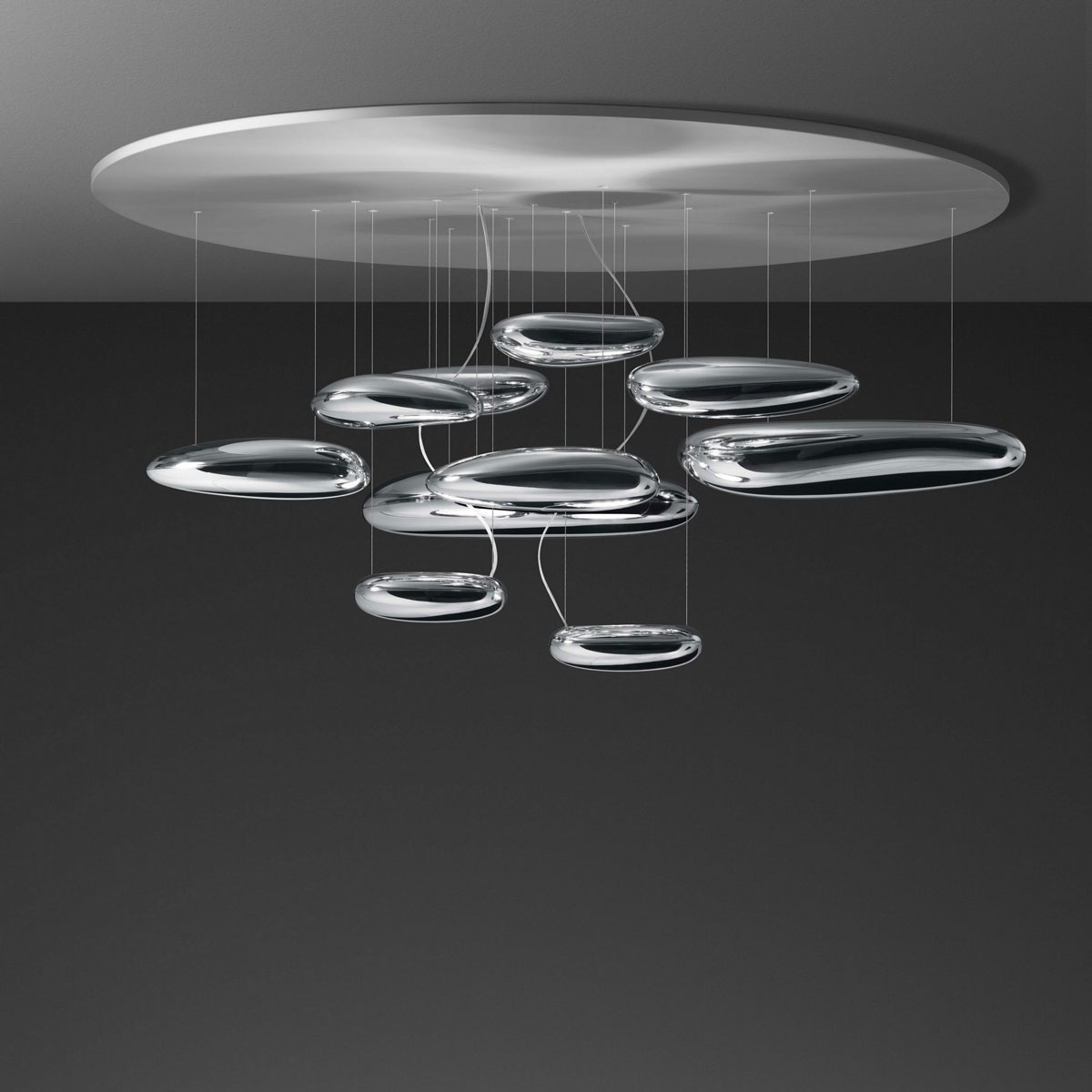
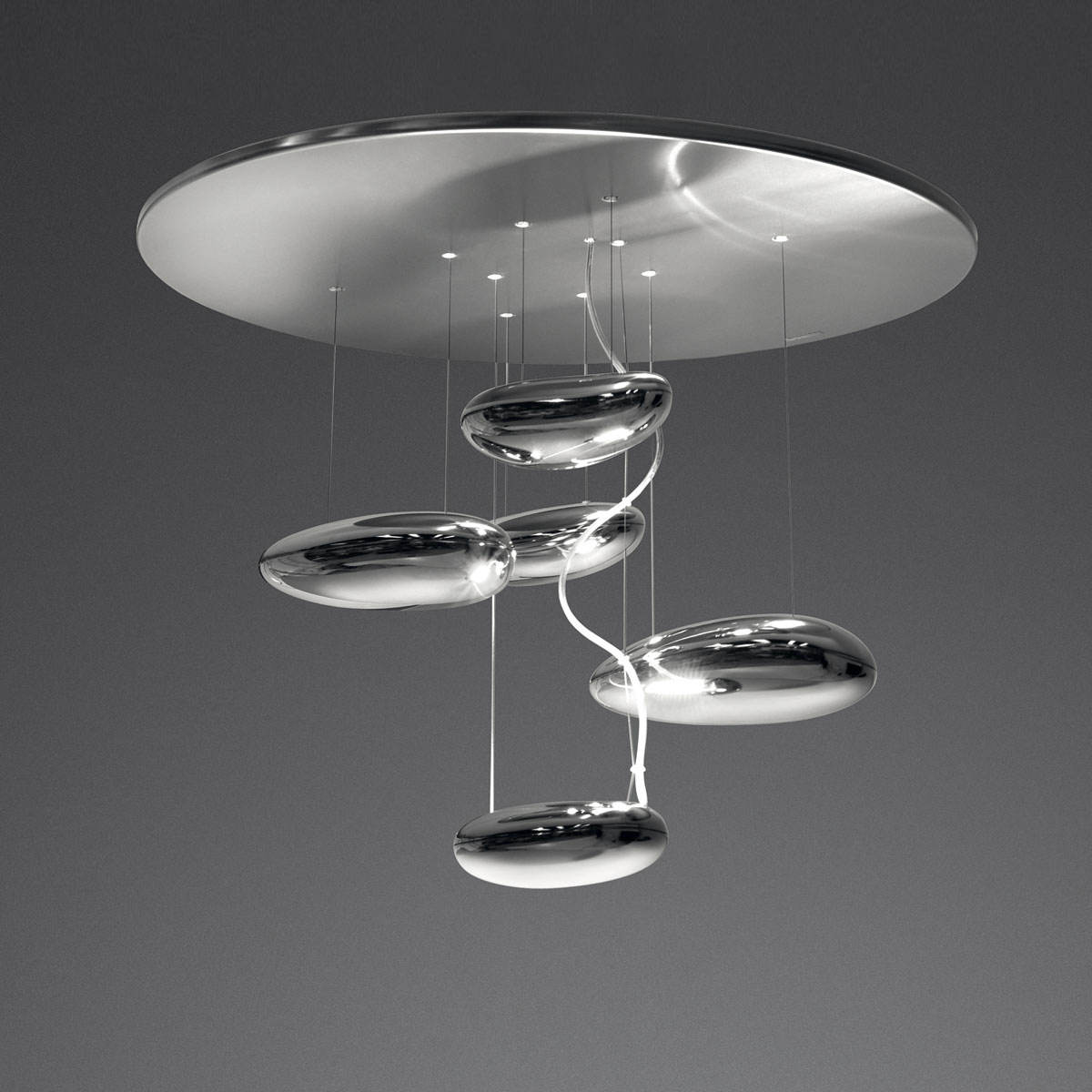
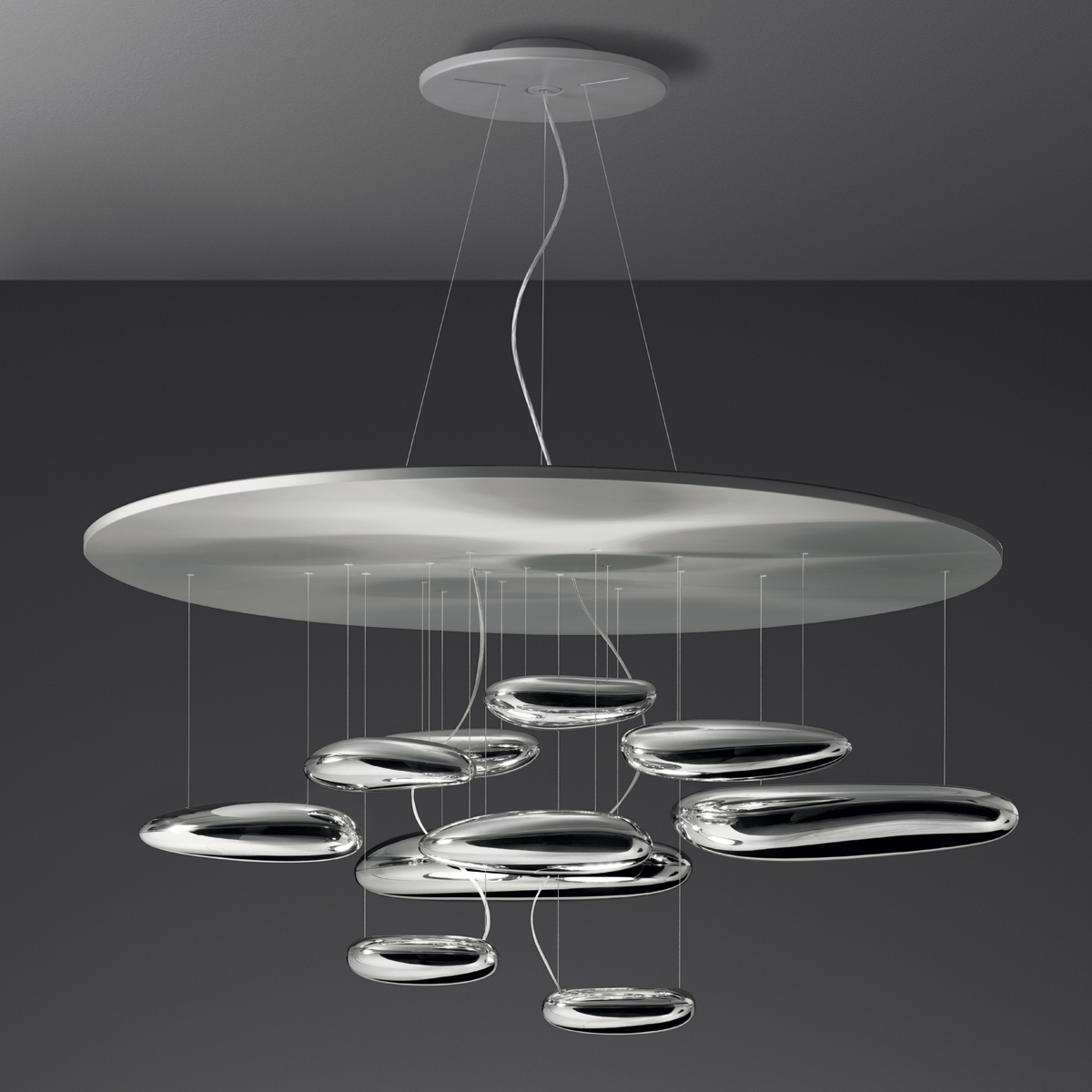
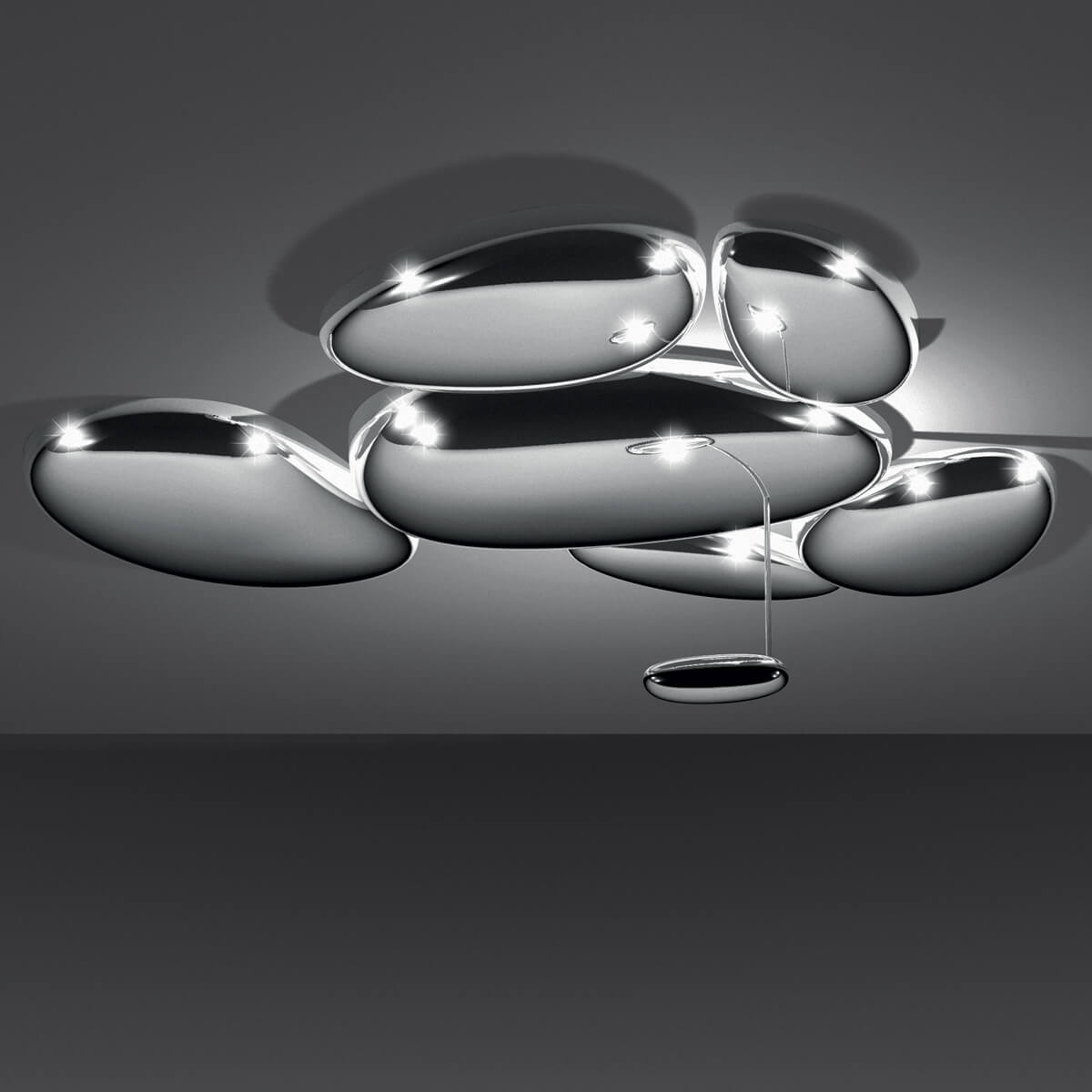
The Artemide Mercury is one of Ross Lovegrove’s best-known lights. Beneath a large aluminium disc, several smoothly shaped, biomorphic elements appear to float freely in space. They reflect one another while also directing light onto the surface above. This creates a complex interplay of light, space and movement.
The glossy elements evoke pebbles, water droplets or liquid metal forms. Depending on the viewing angle, their surfaces reflect the surrounding space and the movements of people within it. Even when switched off, Mercury retains a strong presence: Artemide describes it by day as a sculpture that reflects the dynamics of natural light and its surroundings.
Mercury therefore demonstrates a typical principle of Lovegrove’s design. The organic form is not an end in itself. Only through the reflective surfaces, the arrangement of the elements and the indirect light does the design function as a complete whole. The light changes visually with its surroundings and therefore appears almost alive.
Cosmic Leaf – A Digital Leaf from Another World
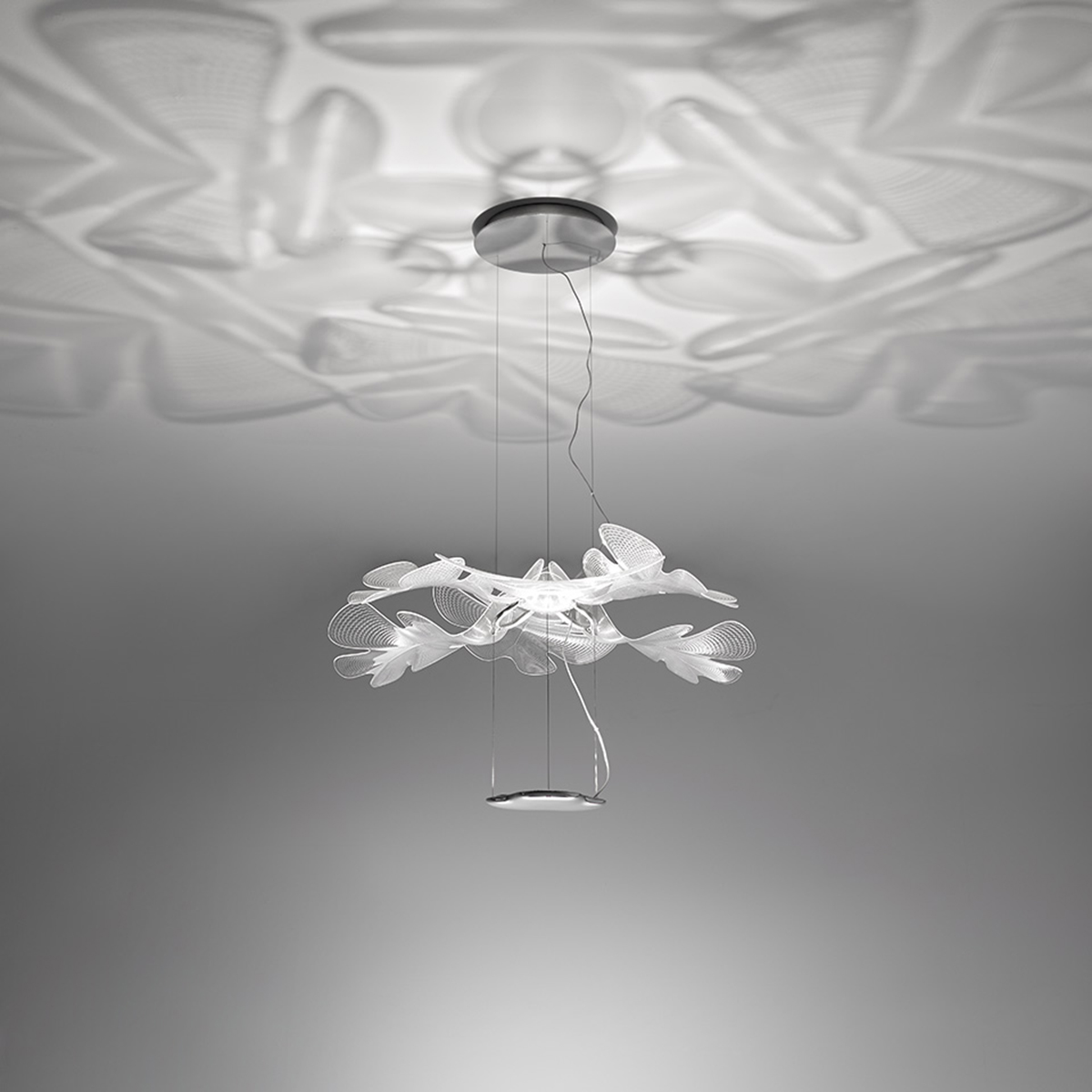
Lovegrove’s affinity with nature is even more immediately visible in Cosmic Leaf. The sculptural light appears like an otherworldly natural form developed through digital processes. Its finely textured surface evokes associations with leaves, scales and protective coverings from the animal world. In the interplay of light and shadow, the transparent body takes on an almost living presence.
The body of the light is made from textured transparent methacrylate and supported by a chrome-plated steel structure. The light reveals the relief-like surface and allows the seemingly weightless form to shift between plant leaf, organism and futuristic artefact. Cosmic Leaf is therefore far more than a functional light source: it combines the atmosphere of a lamp with the presence of a freestanding sculpture.
From Droplet to New Nature – One Shared Idea in Different Forms
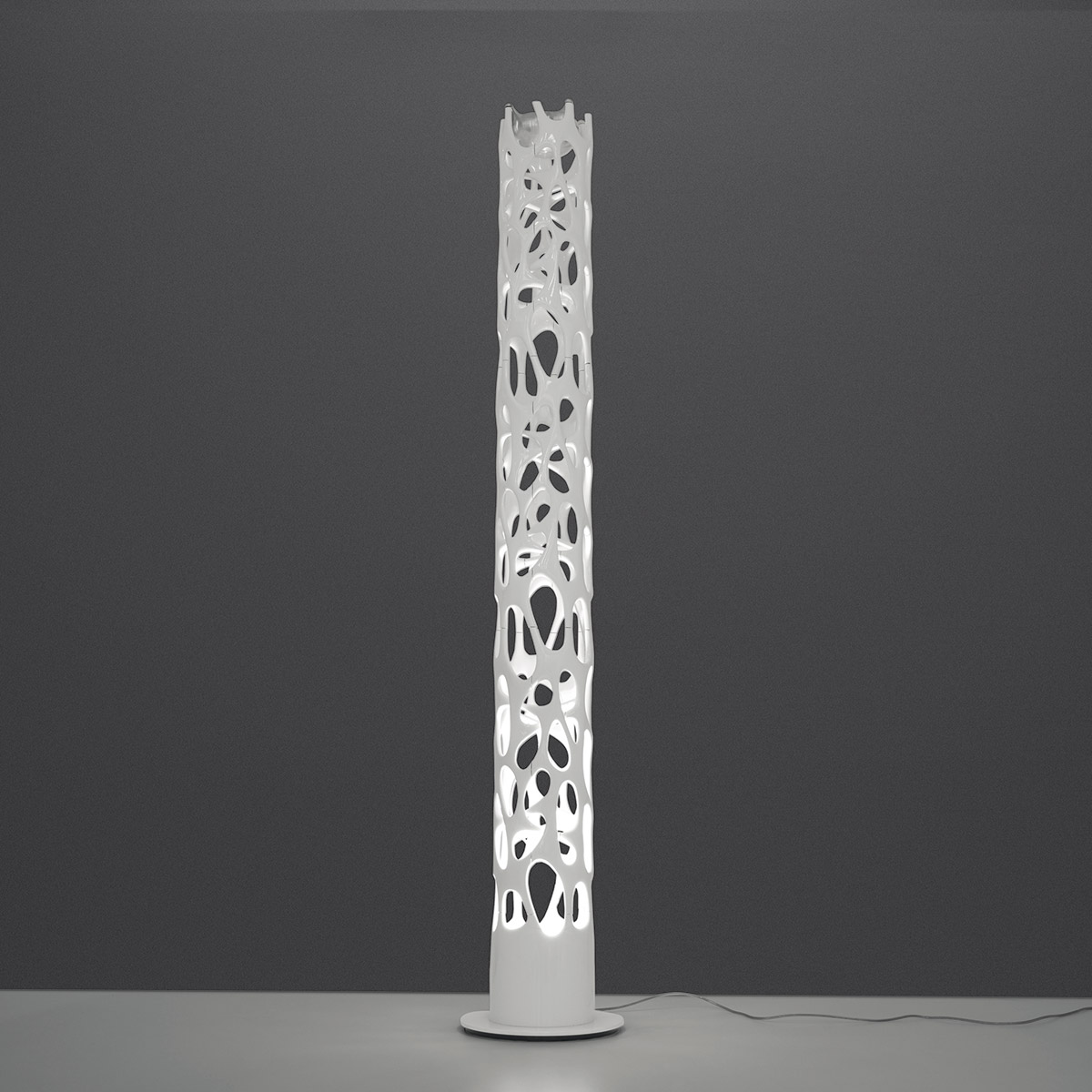
In his other designs for Artemide, Ross Lovegrove also explores the interplay of natural phenomena, material and light. Droplet and Skydro draw on the effect of liquid, reflective surfaces. Cosmic Angel resembles a lightweight skin whose form might have been shaped by an invisible current. The New Nature light sculpture, in turn, condenses the organic design language into a vertical, futuristic-looking object.
What these designs share is an almost weightless appearance. The bodies of the lights resemble droplets, membranes or naturally grown structures. Reflective materials multiply the light, while the technology visually recedes into the background. The result is lighting that does not simply illuminate a room, but changes the way it is perceived.
Solar Tree – Sustainable Light for the City
With Solar Tree, Ross Lovegrove transferred his ideas into public space. Presented in 2007, the project combines a tree-like branching structure with photovoltaics and LED light. It was developed in collaboration with Artemide and Sharp Solar and was initially presented in the surroundings of the MAK in Vienna. Rather than merely optimising conventional street lighting from a technical perspective, Lovegrove designed a highly visible symbol of a new connection between design, energy and public space.
Solar Tree demonstrates particularly clearly what Lovegrove means by Design, Nature and Art. The energy comes from the sun, the technical structure follows the logic of a tree, and the sculptural form gives public space a new identity. A further developed version, Solar Tree 2.0, was later installed in Piazza Gae Aulenti in Milan.
A Designer Between Industry, Science and Art
Ross Lovegrove’s significance extends far beyond individual products. In 2017, the Centre Pompidou in Paris dedicated the extensive exhibition “Mutations-Créations / Ross Lovegrove” to his work. The exhibition focused on the connection between creativity, design and nature, as well as his approach to advanced technologies shaped by ecological concerns.
The Royal Society of Arts also recognised his work by appointing him a Royal Designer for Industry in the field of Product Design. The institution’s current overview lists Lovegrove for the year 2003.
His designs still look like messages from a possible future. Yet their forms do not arise from a desire simply to look futuristic. They are based on a deeper idea: new technologies and materials should not be used merely to dress up the past again and again. They can create a design language of their own—one that is simultaneously progressive, efficient, sensual and closely connected to the principles of nature.
Frequently Asked Questions About Ross Lovegrove
Who is Ross Lovegrove?
Ross Lovegrove is a British industrial and product designer born in Cardiff in 1958. He is known for organically shaped, technologically advanced designs in the fields of lighting, furniture, mobility and product design. After studying in Manchester and at the Royal College of Art, he worked for companies and organisations including Frog Design, Knoll International and numerous international brands.
What is Ross Lovegrove known for?
Ross Lovegrove is best known for combining nature, modern technology and sculptural design. His often flowing, biomorphic forms emerge from his exploration of evolutionary processes, new materials and digital design methods. He summarises his design philosophy with the terms “DNA—Design, Nature, Art” and “organic essentialism”.
What does “DNA – Design, Nature, Art” mean in Ross Lovegrove’s work?
For Ross Lovegrove, DNA stands for Design, Nature and Art. The formula describes the three central areas of his work: functional and industrial design, inspiration from the logic of nature, and the emotional and sculptural qualities of art.
Which lights has Ross Lovegrove designed for Artemide?
Ross Lovegrove’s best-known lights and lighting series for Artemide include Mercury, Mercury Mini, Droplet, Droplet Mini, Skydro, Cosmic Leaf, Cosmic Angel and New Nature. His work for the brand also includes the solar and urban lighting project Solar Tree.
What makes the Artemide Mercury special?
The Artemide Mercury combines indirect light with a sculptural system of reflective, biomorphic elements. These appear to float beneath an aluminium disc, reflecting one another and multiplying the light. Even when switched off, the light responds visually to natural light and movement in its surroundings.
Ross Lovegrove Lights for Residential and Contract Spaces




⭐⭐⭐⭐ Durchschnittliche Shop-Bewertung: 4.7
"Gutes Preis-Leistungs-Verhältnis, wertige Leuchten, problemlose Kaufabwicklung. Immer wieder gern!"
Bewerten Sie Ihre Bestellung und helfen Sie anderen, das Besondere zu finden.